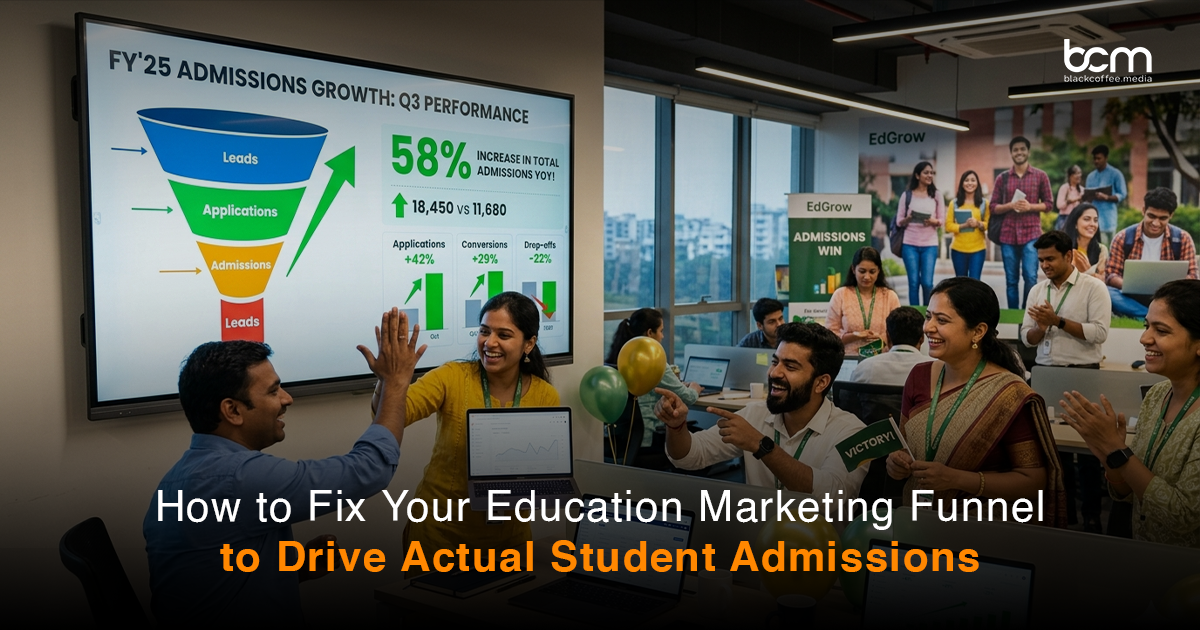
Most MBA and PGDM institutes measure marketing success by leads acquired. The dashboard shows 600 leads this month at ₹750 CPL, and the team celebrates efficiency. Three months later, the batch is half-full, and leadership questions why marketing spend didn’t translate to enrollments.
The problem isn’t lead generation. The problem is treating lead generation as the outcome rather than the starting point. Actual student admission conversion happens when the entire funnel, not just the top, gets optimized for enrollment intent.
This requires different thinking about targeting, messaging, landing pages, nurture sequences, and channel allocation. Institutes that fix these structural elements see dramatic improvements in how many leads actually become enrolled students, often without increasing total marketing spend.
How Do MBA Colleges Generate Student Leads?
How to generate qualified student leads for MBA programs starts with understanding that qualified and volume are often inverse goals. Campaigns optimized for maximum lead count capture broad audiences with varying levels of intent, educational background, and financial capacity. Campaigns optimized for qualified leads accept lower volume in exchange for prospects who match enrollment criteria. The qualification framework should align with actual admission requirements: Educational background compatibility: If your MBA program requires a bachelor’s degree with 50% marks, targeting should exclude prospects who don’t meet this threshold. Broad campaigns targeting “anyone interested in management education” waste budget on unqualified prospects. Career stage alignment: Executive MBA programs need targeting focused on working professionals with 3+ years experience. Full-time MBA programs should target recent graduates or early-career professionals. When both groups enter the same funnel, nurture sequences fail because their decision criteria differ fundamentally. Financial capacity indicators: MBA programs charging ₹8-12 lakhs in fees need prospects who can afford this investment. Targeting parameters should reflect income levels, employer profiles, or educational loan eligibility that suggest financial viability. Geographic relevance: Unless offering fully online programs, targeting should concentrate on regions within commutable distance or where relocation makes sense. A Mumbai-based weekend MBA program wastes spend targeting prospects in Chennai who can’t attend. Channel selection impacts lead quality significantly. LinkedIn allows precise targeting by job title, industry, company size, and seniority, making it effective for executive MBA and specialized master’s programs despite higher CPLs. Google Search captures high-intent prospects actively researching specific program types. Meta offers scale and lower CPLs but requires tighter creative and landing page optimization to maintain quality. The best lead generation strategies for PG courses layer multiple qualification signals:- Campaign structure separates awareness (broad audience education) from conversion (decision-stage targeting)
- Ad creative speaks to specific prospect segments rather than generic audiences
- Landing pages collect information that indicates qualification (current role, years of experience, educational background)
- Lead scoring prioritizes follow-up based on engagement depth and profile fit
What Is the Best Way to Increase Student Admissions for PG Programs?
How to increase MBA admissions requires optimizing every stage of the funnel, not just lead acquisition. Most institutes lose 60-80% of potential enrollments between lead capture and application submission due to poor nurture infrastructure and weak conversion mechanics.Stage 1: Targeting Precision
Start with tighter audience definition. Instead of targeting “people interested in MBA,” target:- Working professionals in specific industries (finance, consulting, tech) searching for career acceleration
- Recent graduates from target undergraduate programs researching full-time options
- Mid-career managers exploring executive education for leadership roles
Stage 2: Message-Market Fit
Creative should address the specific concerns of each segment: For working professionals: How will this fit with my job? What’s the weekend schedule? How long is the program? What salary increase can I expect? Which companies recruit from this program? For recent graduates: What specializations are offered? What’s the placement record? What’s the average salary? What kind of companies recruit? What’s the peer profile? For career changers: Can I switch industries through this program? What support exists for career transitions? Which companies have hired people making similar switches? Generic creative promising “world-class education” and “excellent placements” doesn’t address these questions. Specific creative showcasing salary data by specialization, weekend batch schedules, career transition case studies, and company-specific placement records does.Stage 3: Landing Page Optimization
Improve landing page conversion for PG programs by structuring pages around decision factors, not institutional ego. Decision-stage prospects need immediate access to:- Fee structure and ROI analysis: Total program cost, payment plans, loan partnerships, median salary by specialization, payback period calculations
- Placement data: Percentage placed, median package, top recruiters, industry distribution, role distribution, career progression examples
- Program logistics: Schedule (weekend/weekday), duration, location, online/offline mix, attendance requirements
- Specialization options: Available tracks, faculty for each specialization, industry tie-ups, live projects
- Admission process: Eligibility criteria, application deadlines, required documents, selection process, timeline
- Headline: Specific value proposition (not “Transform Your Career” but “Executive MBA for Working Professionals: Weekend Classes, 18-Month Program, ₹12.8L Average Package”)
- Subheadline: Key differentiator or proof point
- Above-fold conversion element: Form or calendar link for counseling session
- Placement outcomes: Median package, top recruiters, percentage placed within 90 days
- Program structure: Duration, schedule, format, specializations
- Fee structure and ROI: Total cost, financing options, salary comparison
- Faculty highlights: Key professors, industry experience, research areas
- Admission process: Clear steps, deadlines, requirements
- Testimonials: Specific outcomes (not “great experience” but “switched from IT to consulting, joined Deloitte at ₹18L”)
- Bottom conversion element: Repeated form or CTA
Stage 4: Nurture Infrastructure
Most student admission conversion failures happen in nurture. Prospects download a brochure, receive a generic “thank you for your interest” email, then never hear from the institute again unless they proactively reach out. Effective nurture sequences are: Behavior-triggered: Someone who downloaded placement data receives testimonials from recent graduates. Someone who attended a webinar about finance specialization receives content about finance career paths, finance faculty profiles, and finance industry partnerships. Multi-channel: Email, SMS, retargeting ads, and counselor outreach work in coordination. Email shares detailed content. SMS reminds about deadlines. Retargeting keeps the program top-of-mind. Counselors provide personalized guidance. Objection-addressing: Common concerns (ROI justification, program rigor while working, career switching viability, placement support) get systematically addressed through content sequencing. Deadline-driven: As application deadlines approach, urgency increases. Early-bird fee discounts, batch seat limits, and scholarship deadlines create natural urgency without feeling pushy. A basic nurture sequence for working professional prospects might look like: Day 1: Brochure delivery + weekend schedule overview Day 3: Alumni testimonial (someone with similar background) Day 5: ROI calculator + salary progression data Day 7: Counselor outreach call (if lead score is high) Day 10: Webinar invitation (industry-specific or specialization-specific) Day 14: Placement report download Day 21: Application deadline reminder + early-bird discount mention Day 28: Final deadline urgency + scholarship information Each touchpoint should provide value (useful information, tools, insights) rather than just asking for the application.Stage 5: Lead Scoring and Prioritization
Not all leads deserve equal attention. Lead scoring helps counselors focus time on prospects most likely to convert. High-value signals (20-30 points each):- Attended webinar or campus visit
- Downloaded fee structure or placement report
- Visited application page multiple times
- Responded to counselor outreach
- Matches ideal student profile (education, experience, location)
- Downloaded brochure
- Watched program overview video
- Opened multiple nurture emails
- Engaged with retargeting ads
- Form submission only
- Single page visit
- Generic inquiry
How Can Lead Quality Be Improved in Education Marketing?
Reduce cost per lead in education marketing is the wrong goal if those leads don’t convert. The actual goal should be to reduce cost per enrollment, which means accepting higher CPL for better quality.Improve Targeting Specificity
Broader targeting delivers cheaper leads but worse conversion. Tighter targeting costs more per lead but delivers better enrollment rates. Broad targeting example: “People interested in MBA” (CPL: ₹600, conversion to enrollment: 1.5%) Specific targeting example: “Working professionals in finance roles with 3-5 years experience researching executive MBA programs” (CPL: ₹1,400, conversion to enrollment: 8%) The broad campaign delivers leads at less than half the cost, but the specific campaign delivers 5x better conversion. Cost per enrollment: ₹40,000 vs ₹17,500. The “expensive” leads are actually cheaper.Use Negative Targeting
Exclude audiences unlikely to convert:- People below minimum age (for executive programs requiring work experience)
- Locations outside serviceable geography
- Income levels incompatible with program fees
- Educational backgrounds below admission requirements
- Job titles indicating wrong career stage
Qualify at the Ad Level
Creative should describe what the program is and isn’t. Someone reading “Executive MBA: Weekend Classes for Working Professionals, 5+ Years Experience Required” self-selects out if they’re a recent graduate. This reduces unqualified clicks.Add Qualification Questions to Forms
Instead of just name, email, and phone, include:- Current job role and years of experience
- Educational background
- Preferred program format (full-time/part-time/weekend)
- Expected start date
- Awareness of fee range
Which Channels Deliver the Best Results for Student Acquisition?
Best student acquisition strategies for MBA institutes vary by program type, but certain patterns consistently emerge across successful campaigns.Google Search: High Intent, High Conversion
Prospects searching “executive MBA weekend programs Bangalore” or “PGDM finance placement statistics” demonstrate clear intent. They’re comparing specific programs, not exploring whether to pursue higher education. Best for: Capturing decision-stage prospects actively comparing options Typical CPL: ₹1,200-₹2,500 Conversion to enrollment: 6-12% Optimization priority: Keyword specificity, ad copy differentiation, landing page conversion Search works when:- Keyword strategy focuses on decision-intent terms (program types, locations, specializations, placement outcomes)
- Ad copy highlights specific differentiators
- Landing pages directly answer the search query
- Retargeting captures prospects who visited but didn’t convert
LinkedIn: Precision Targeting for Executive Programs
LinkedIn’s professional targeting allows unprecedented precision for executive MBA, specialized master’s, and professional certification programs. Best for: Executive education, specialized programs requiring specific professional backgrounds Typical CPL: ₹2,000-₹4,000 Conversion to enrollment: 8-15% Optimization priority: Targeting precision, professional messaging, ROI focus LinkedIn works when:- Targeting uses job titles, seniority, industries, company size
- Creative addresses professional concerns (career growth, salary increase, leadership skills)
- Landing pages emphasize outcomes relevant to that professional segment
- Follow-up acknowledges professional context
Meta: Scale and Retargeting Power
Meta offers massive reach and sophisticated retargeting but requires stronger creative and landing page optimization to maintain lead quality. Best for: Full-time programs, reaching younger demographics, retargeting engaged prospects Typical CPL: ₹600-₹1,500 Conversion to enrollment: 3-8% Optimization priority: Creative testing, audience segmentation, retargeting sequences Meta works when:- Creative is highly specific (not generic institutional branding)
- Targeting layers multiple parameters (demographics + interests + behaviors)
- Retargeting sequences address objections and create urgency
- Landing pages convert at 12%+ (Meta traffic requires stronger optimization)
YouTube: Building Awareness and Credibility
YouTube works for longer consideration cycles, allowing prospects to explore faculty, facilities, student experiences, and program details through video content. Best for: Building program awareness, showcasing differentiation, supplementing other channels Typical CPL: ₹800-₹1,800 Conversion to enrollment: 2-6% Optimization priority: Video content quality, targeting precision, integration with other channels YouTube works when:- Content provides genuine value (faculty lectures, campus tours, student testimonials, career guidance)
- Targeting reaches prospects early in research
- Retargeting captures engaged viewers across other channels
- Video ads drive to specific landing pages, not generic website
Channel Mix Strategy
Effective education marketing funnel examples typically use multiple channels in coordination: Awareness stage: YouTube + Meta broad targeting (introduce program, build familiarity) Consideration stage: Google Search + LinkedIn + Meta retargeting (engage prospects comparing options) Decision stage: Google Search + LinkedIn + retargeting across all platforms (drive applications) Budget allocation should reflect enrollment contribution, not just CPL:- Track which channels drive not just leads, but counseling session attendance, campus visits, and actual applications
- Allocate budget based on cost per enrollment, not cost per lead
- Test channel combinations (prospects who see YouTube + Search perform better than either alone)
Practical Framework: 90-Day Funnel Optimization
Month 1: Audit and Baseline
Week 1-2: Audit current performance- Calculate actual lead-to-enrollment conversion rate
- Identify drop-off points (lead to counseling session, session to campus visit, visit to application, application to enrollment)
- Analyze lead quality by channel and campaign
- Review landing page conversion rates
- Assess nurture sequence effectiveness
- Set up proper attribution (multi-touch, not just last-click)
- Create lead scoring system
- Build conversion tracking for each funnel stage
- Establish enrollment cost baseline by channel
Month 2: Optimization Implementation
Week 5-6: Targeting and creative refinement- Tighten targeting parameters based on enrolled student profiles
- Develop segment-specific creative (working professionals vs. recent graduates vs. career changers)
- Build decision-stage landing pages for each segment
- Implement negative targeting to exclude unqualified audiences
- Create behavior-triggered email sequences
- Set up retargeting campaigns for engaged prospects
- Integrate SMS reminders for key touchpoints
- Provide counselors with lead context and scoring
Month 3: Scale and Refine
Week 9-10: Channel reallocation- Shift budget toward channels driving enrollments, not just cheap leads
- Scale campaigns with best enrollment contribution
- Test new audience segments that match enrolled student profiles
- Expand retargeting to all engaged prospects
- Implement weekly creative refreshes
- A/B test landing page elements
- Refine lead scoring based on conversion data
- Optimize nurture sequences based on engagement patterns
How BlackCoffee Media Approaches Education Marketing
We’ve built enrollment systems for MBA programs, PGDM institutes, and specialized master’s programs across India. Our approach differs from typical agencies because we optimize for admissions, not lead volume. Our process:- Enrollment analysis: We study your enrolled students to understand which sources, campaigns, and touchpoints actually drive admissions
- Funnel reconstruction: We identify and fix drop-off points between lead capture and enrollment
- Channel optimization: We allocate budget based on enrollment contribution, accepting higher CPL for better conversion
- Nurture automation: We build sequences that keep prospects engaged through lengthy decision cycles
- Systematic testing: We continuously refine targeting, creative, landing pages, and follow-up based on conversion data